Quick answer: Dashain (दशैं) is Nepal's longest and biggest festival. It is a 15-day Hindu festival that celebrates the victory of the goddess Durga over the demon Mahishasura, and of good over evil. In 2026 (2083 BS) it runs from Ghatasthapana on Sunday 11 October to Kojagrat Purnima on Sunday 25 October. The main day, Bijaya Dashami (tika day), is Wednesday 21 October 2026 (Kartik 4, 2083).
Dashain Tika Sait 2083
नेपालमा २०८३ सालको विजयादशमीको टीकाको उत्तम साइत कात्तिक ४ गते बुधबार (अक्टोबर २१, २०२६) बिहान १०:२६ बजे रहेको छ।
Find the Dashain tika sahit (sait or muhurat) for Nepal and 35 locations abroad below. Every time is AM in the listed location’s local clock time. These are individually listed local saits, not conversions of Nepal’s 10:26 AM. The local date is 20 October or 21 October 2026 as shown.
| Location / country | Local date (AD) | Tika sait (local time) |
|---|---|---|
| Nepal (Kathmandu) | 21 October 2026 | 10:26 AM |
| Delhi, India | 21 October 2026 | 09:11 AM |
| Thimphu, Bhutan | 21 October 2026 | 10:14 AM |
| New York, USA | 20 October 2026 | 10:11 AM |
| Frankfort, Kentucky, USA | 20 October 2026 | 10:47 AM |
| Owensboro, Kentucky, USA | 20 October 2026 | 11:45 AM |
| Texas, USA | 20 October 2026 | 10:27 AM |
| Washington DC, USA | 20 October 2026 | 10:21 AM |
| California, USA | 20 October 2026 | 09:51 AM |
| Toronto, Canada | 20 October 2026 | 10:41 AM |
| Vancouver, Canada | 20 October 2026 | 10:55 AM |
| Tokyo, Japan | 21 October 2026 | 10:17 AM |
| Sydney, Australia | 21 October 2026 | 09:21 AM |
| Brisbane, Australia | 21 October 2026 | 08:25 AM |
| Adelaide, Australia | 21 October 2026 | 09:15 AM |
| Canberra, Australia | 21 October 2026 | 09:07 AM |
| Tasmania, Australia | 21 October 2026 | 08:55 AM |
| Perth, Australia | 21 October 2026 | 08:54 AM |
| Darwin, Australia | 21 October 2026 | 09:31 AM |
| Melbourne, Australia | 21 October 2026 | 09:30 AM |
| Lisbon, Portugal | 20 October 2026 | 09:41 AM |
| London, UK | 20 October 2026 | 10:55 AM |
| Paris, France | 20 October 2026 | 11:31 AM |
| Wellington, New Zealand | 21 October 2026 | 09:23 AM |
| Oslo, Norway | 20 October 2026 | 11:50 AM |
| Kuala Lumpur, Malaysia | 21 October 2026 | 10:47 AM |
| Saudi Arabia | 21 October 2026 | 10:01 AM |
| Abu Dhabi, UAE | 21 October 2026 | 10:31 AM |
| Doha, Qatar | 21 October 2026 | 09:41 AM |
| Bangkok, Thailand | 21 October 2026 | 10:07 AM |
| Seoul, South Korea | 21 October 2026 | 11:13 AM |
| Tel Aviv, Israel | 20 October 2026 | 11:13 AM |
| Singapore | 21 October 2026 | 10:31 AM |
| Hong Kong | 21 October 2026 | 10:27 AM |
| Yangon, Myanmar | 21 October 2026 | 09:57 AM |
| Geneva, Switzerland | 20 October 2026 | 10:31 AM |
Source: International Panchanga Decision Committee (World Astro Federation): Vijaya Dashami 2083 notice, Ashwin 21, 2083. Location names are retained as listed in the notice; Texas, California, Tasmania and Saudi Arabia do not specify a city. For another city, check its local Panchanga rather than applying a countrywide time.
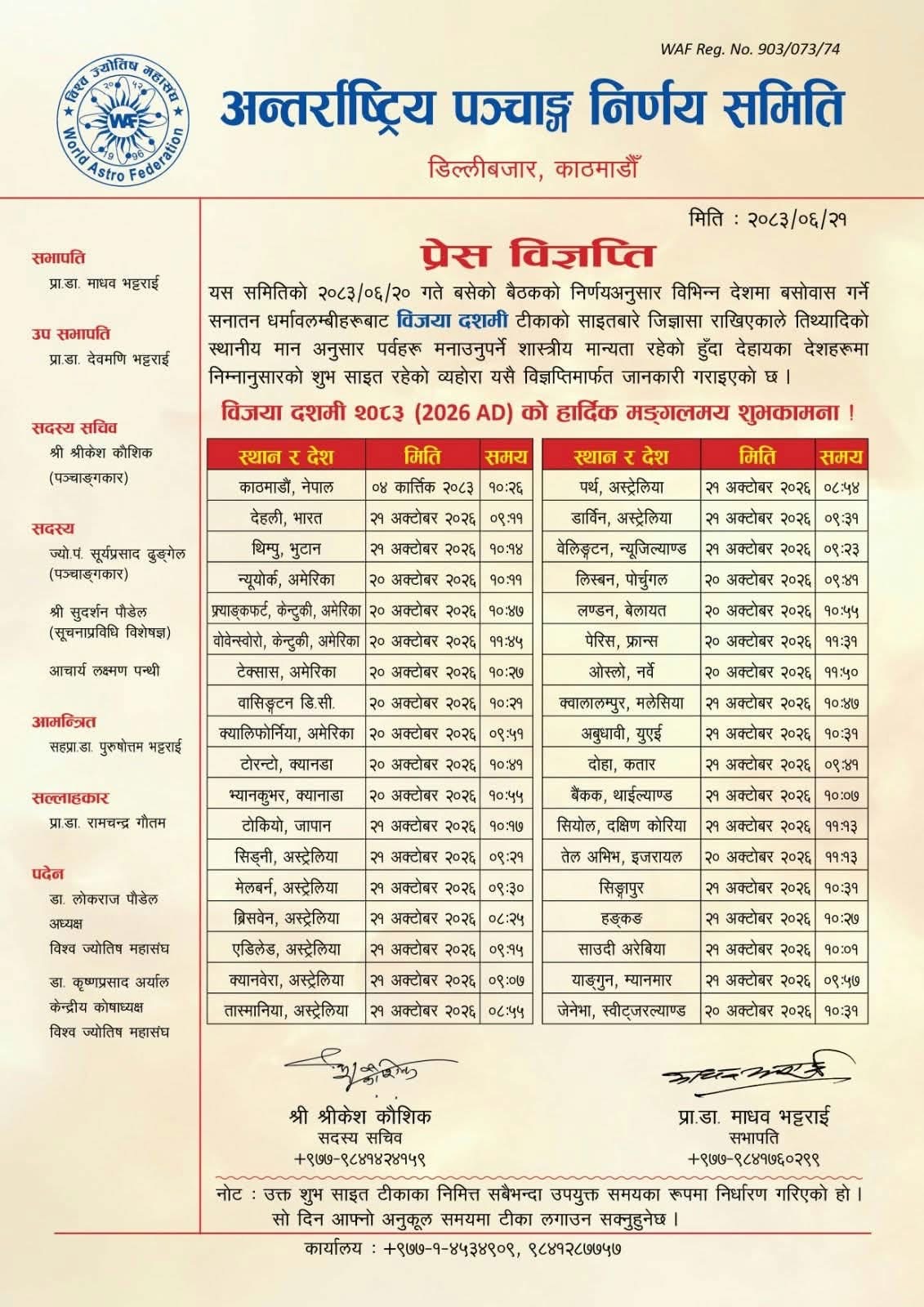
The committee describes these as the most suitable moments for tika and notes that tika may also be received at a convenient time on the respective day. Follow your family’s observance and local Panchanga.
What is Dashain?
Dashain (also written Dasain, and known as Bada Dashain, बडादशैं) is the most important national festival in Nepal. Families who live far apart travel home, elders bless younger relatives, homes are cleaned and decorated, and feasts, games and prayers fill about two weeks.
The festival has several names:
- Dashain / Dasain (दशैं): from the Sanskrit dashami, meaning "tenth", the final and most important day.
- Bada Dashain (बडादशैं): "Bada" means big or important.
- Bijaya (Vijaya) Dashami: "the tenth day of victory", the main day of the festival.
- Nauratha: from Navaratri, "nine nights", the nine-night worship of Durga that leads up to the tenth day.
- Mohani: the Newar name for the festival, with its own customs (see below).
Dashain falls in the Nepali month of Ashwin (Ashoj) or the start of Kartik, which is September or October in the English calendar. It begins on the bright half of the moon (Shukla Paksha) and ends on the full moon (Purnima). It is the longest festival in both the Bikram Sambat and Nepal Sambat calendars.
Dashain is observed mainly in Nepal. It is also celebrated by Nepali-speaking communities in Sikkim, Darjeeling and Assam in India, by the Lhotshampa community of Bhutan, by Gurkha communities in Myanmar, and by Nepali communities around the world.
Dashain 2026 dates (2083 BS)
These dates match the 2083 BS calendars published by several Nepali sources. The Nepal Panchanga Nirnayak Samiti (Nepal Calendar Determination Committee) sets the official dates and the tika time, so check it for last-minute changes.
| Day | Festival | Date (AD) | Date (BS) |
|---|---|---|---|
| Sun | Ghatasthapana (Day 1) | 11 October 2026 | Ashwin 25, 2083 |
| Sat | Fulpati (Day 7) | 17 October 2026 | Ashwin 31, 2083 |
| Sun | Maha Ashtami (Day 8) | 18 October 2026 | Kartik 1, 2083 |
| Tue | Maha Navami (Day 9) | 20 October 2026 | Kartik 3, 2083 |
| Wed | Bijaya Dashami, main tika day (Day 10) | 21 October 2026 | Kartik 4, 2083 |
| Thu | Papankusha Ekadashi (Day 11) | 22 October 2026 | Kartik 5, 2083 |
| Sun | Kojagrat Purnima (Day 15, last day) | 25 October 2026 | Kartik 8, 2083 |
Some calendars and news reports differ by a day for Maha Ashtami because the eighth and ninth lunar days overlap in 2026. If your family follows a priest's almanac, follow that.
Public holidays: Government offices, schools and banks usually close for about a week around the main days. For 2026 the holiday window is widely reported as 17–22 October. Confirm the final list with the Ministry of Home Affairs.
Why Dashain is celebrated
Dashain is a celebration of good defeating evil. Two stories explain it, and Nepali families often honour both.
Durga defeats Mahishasura
In the Shakta tradition, the demon Mahishasura gained such power that no god could defeat him. He drove the gods out of heaven. The gods combined their energies, and the goddess Durga was born. After a long battle, Durga killed Mahishasura on the tenth day. The first nine days of Dashain represent the battle, in which different forms of Durga fight the demon. The tenth day, Bijaya Dashami, marks her victory. The Durga Saptashati (also called the Chandi or Devi Mahatmya), the scripture that tells this story, is recited during these days.
Rama defeats Ravana
In the Ramayana, Rama defeated the demon king Ravana, who had abducted Rama's wife Sita, on the tenth day. Many communities, especially in India and in some parts of Nepal, link the tenth day to this victory.
Season and community
Dashain comes after the monsoon, as the rice harvest approaches and the weather clears. It is a time to stop work, rest, reunite and share food. The kites that fill the sky are said to remind the gods to stop the rain.
The 15 days of Dashain, day by day
Dashain lasts 15 days, from the first day of the bright fortnight in Ashwin to the full moon. The most important days are the 1st, 7th, 8th, 9th, 10th, 11th and 15th.
Days 1–6: Ghatasthapana and the Dashain Ghar
Ghatasthapana (घटस्थापना) means "placing the pot" and starts the festival. At an auspicious time set by astrologers, a priest or the head of the household places a kalasha (holy pot) in the centre of a prepared bed of sand. The kalasha stands for Durga. It is filled with holy water, and barley seeds are sown in the sand around it. The priest invites Durga to stay in the pot for the nine days of Navaratri.
The prayer room is called the Dashain Ghar. Traditionally it is kept pure and closed to outsiders. The kalasha is worshipped morning and evening and kept out of direct sunlight. By the tenth day the barley has sprouted into pale yellow shoots five to six inches long. These are the jamara (जमरा), the sacred sprouts used in the tika blessing.
In Madhesh and the wider Mithila region, Ghatasthapana is celebrated with the Jhijhiya folk dance. Across Nepal, you will also hear Malshree dhun, a devotional tune. It is among the oldest surviving Newar devotional music, dates back to the 17th century, and marks the start of the festival on radio and television.
During days 2 to 6, families keep up daily worship, clean the house, shop for clothes and food, and prepare for visitors. Each day of Navaratri honours a different form of Durga (see the table below).
Day 7: Fulpati (फूलपाती)
Phul means flower and pati means leaf. On Fulpati (फूलपाती), families bring a sacred bundle into the Dashain Ghar. The bundle contains the kalasha, jamara, banana stalks and sugarcane tied with red cloth.
The national Fulpati is the best-known version. Traditionally, Magar people carry it from Gorkha to Kathmandu, a walk of about three days and roughly 169 km. It arrives at the Tundikhel parade ground, where the President attends a ceremony with a military parade, a rifle salute and a 21-gun salute. Before 2008 the bundle went to the royal palace. Since Nepal became a republic it goes to the President's residence, and the Tundikhel ceremony continues as a statement of tradition.
In towns and villages across Nepal, and in Darjeeling and Sikkim, local Fulpati processions carry the bundle through the streets. Neighbours offer flowers and fruit as it passes, and the Naumati band plays.
Day 8: Maha Ashtami (महाअष्टमी)
The eighth day, Maha Ashtami (महाअष्टमी), is dedicated to the fierce form of the goddess, Kali. The night of Ashtami is called Kal Ratri ("Black Night"). Many temples, especially Durga and Kali temples and the old palace courtyards in Kathmandu, are active through the night with worship. Animal offerings are made at many temples and in some homes. Families take the blessed meat home, cook it as prasad (food blessed by the deity) and eat it together.
Day 9: Maha Navami (महानवमी)
On Maha Navami (महानवमी), the last day of Navaratri, rituals reach their peak. Craftspeople, drivers, mechanics, traders and factory workers worship their tools, vehicles and machines, and many put a tika on them to bring safety and success for the year. Government and military bodies hold their own rituals.
The Taleju temples in Kathmandu, Patan and Bhaktapur, normally closed to the public, open their doors to everyone only on this day. Thousands of devotees queue to see the goddess.
Day 10: Bijaya Dashami (बिजया दशमी)
The tenth day, Bijaya Dashami (विजया दशमी), is the heart of the festival. After morning prayers, elders put tika and jamara on the foreheads of younger relatives, give blessings and give dakshina, a gift of money. Families visit each other in order of age and seniority. Offices, shops and many roads go quiet. See the next section for details.
Day 11: Papankusha Ekadashi (पापाङ्कुशा एकादशी)
The day after Bijaya Dashami is Ekadashi, the eleventh lunar day. Some people fast, listen to the Papankusha Ekadashi story and visit temples. Many continue to visit relatives and receive tika. It is also traditional to give gifts such as grain, sesame, umbrellas and shoes. Believers hold that this charity brings spiritual merit.
Days 12–14: Visiting and relaxing
Tika-giving continues until the full moon. Families who could not meet on the main day visit now, and the house stays full of food, cards and conversation.
Day 15: Kojagrat Purnima (कोजाग्रत पूर्णिमा)
The full moon concludes Dashain on Kojagrat Purnima (कोजाग्रत पूर्णिमा). Kojagrat means "who is awake". Hindus believe the goddess Lakshmi descends on this night and blesses those who stay awake. Families worship Lakshmi, and many stay up playing cards. It is also called Sharad Purnima. The festival ends, and soon Tihar begins.
Dashain tika: how it works and the 2026 tika time
Tika (टिका) is the main ritual of Dashain. It is a blessing, and it is the reason families travel across the country.
What the tika is made of
The red Dashain tika is a mix of rice, yogurt (dahi) and vermilion powder (abir). The rice grains are meant to be whole, a sign of unbroken blessings. Red represents the blood bond of family and community, and the power of the goddess. The jamara sprouts are placed on the head or behind the ear alongside the tika.
How tika is given
- The younger person sits facing the elder.
- The elder applies the tika to the forehead with the thumb or ring finger, and places the jamara.
- The elder says a blessing. Traditional Sanskrit blessings for boys and men wish for a long life, strength, truthfulness, wisdom and good fortune, modelled on heroes of Hindu epics. The blessing for girls and women honours them as forms of Durga.
- The elder gives dakshina.
- The younger person bows or touches the elder's feet.
Families often start with the head of the house, usually the oldest relative, and move through the family. If elders live far away, many people phone, video call or send tika money, and receive tika once they travel home.
Tika time 2026 (Dashain Tika Sait)
Dashain Tika Sait 2083 in Nepal is 10:26 AM Nepal Standard Time (UTC+05:45) on Wednesday, 21 October 2026 (Kartik 4, 2083 BS). Use the separate local date and time listed for your location abroad. See the full Dashain Tika Sait 2083 table above.
Red tika and white tika
Nepali Hindus use red tika. In Bhutan the Lhotshampa community uses white tika, and the King of Bhutan gives tika to representatives of the Hindu community at a Thimphu temple. In Bhaktapur, some Newar families wear a black tika on Bijaya Dashami as part of Mohani customs.
The nine forms of Durga
From the first day, Durga is worshipped in nine forms in order. The Saptashati is recited, and the three great powers of Mahakali, Mahalakshmi and Mahasaraswati are also honoured.
| Day | Form of Durga |
|---|---|
| 1 | Shailaputri |
| 2 | Brahmacharini |
| 3 | Chandraghanta |
| 4 | Kushmanda |
| 5 | Skandamata |
| 6 | Katyayani |
| 7 | Kalaratri |
| 8 | Mahagauri |
| 9 | Siddhidatri |
This is the standard Navaratri sequence. Local customs in Nepal also link particular days, such as Ashtami with Kali, so the pairing of days and forms can vary by family and region. Follow your family's priest.
Dashain food
Dashain is a food festival. Because families gather in large numbers and the festival lasts two weeks, kitchens are busy.
- Meat: goat (khasi) is the classic Dashain meat. Demand for meat rises sharply, and buffalo, chicken and duck are also eaten. Meat blessed at a ritual is eaten as prasad.
- Sel roti: a sweet, ring-shaped rice bread fried in oil, often made for Dashain and Tihar.
- Rice, dal and seasonal vegetables: the base of festival meals.
- Sweets and yogurt: dahi (yogurt) is part of the tika itself and of many dishes. Families also serve sweets and fruit to guests.
- Vegetarian and Brahmin households: many families eat vegetarian food for the nine days of Navaratri and offer fruit, flowers and coconut instead of animals.
Family recipes and local dishes differ widely, so what is served in Kathmandu, the hills, the Terai and Newar households varies.
Kites, swings, cards and other Dashain traditions
- Kite flying: as Dashain approaches, rooftops fill with kites. People of all ages fly them, and the shout "changa chet" is heard when one kite cuts another's string.
- Bamboo swings (ping): villages build tall bamboo swings, some over twenty feet high, about a week before Ghatasthapana. They stay up until Tihar is over. Children and teenagers love them.
- Playing cards: card games are a Dashain tradition, especially on Kojagrat Purnima night.
- New clothes: buying and wearing new clothes is central to Dashain, and many families buy for the whole household. Shops hold their biggest sales of the year.
- Fairs: village fairs offer rides and snacks, and cities hold commercial fairs and cultural shows.
- Cleaning and decorating: homes are cleaned, repainted and decorated before Ghatasthapana.
- Music and media: Malshree dhun on radio and TV, and new Dashain songs and videos, signal the season.
Dashain beyond the Nepali Hindu household
Newar Mohani
The Newar people of the Kathmandu Valley celebrate Mohani, a closely related festival that is also observed by Newar Buddhists. It centres on the goddess Taleju, the family deity of the Malla kings, and on each family's own deity. The Taleju temples open to the public on Navami.
In Bhaktapur, the sacred masked Nava Durga dance is performed. It honours the nine goddesses who are believed to protect the city. In some Newar communities, Bijaya Dashami also brings a different tika, and large fairs and processions take place at temples such as Bramhayani in Bhaktapur.
Madhesh and Mithila
In Madhesh, Ghatasthapana is marked with the Jhijhiya dance, and Durga Puja pandals (decorated temporary shrines) are common, as in neighbouring parts of India.
Nepali communities in India, Bhutan and Myanmar
In Darjeeling, Sikkim and Assam, Dashain is the biggest festival, and red tika is used. Many Nepalis working in India travel home, which causes crowds at border towns. In Bhutan, Dashain has been a national holiday since 1980. In Myanmar, Nepali-speaking communities keep a smaller celebration, with fewer animal sacrifices.
The Nepali diaspora
Families in the Gulf, Malaysia, Japan, Korea, the UK, the US, Australia and beyond hold Dashain gatherings, often on the weekend closest to Bijaya Dashami, because the day is not a holiday where they live. Many create a small Dashain Ghar, grow jamara at home, order meat and sel roti from Nepali shops, and call home for tika.
The animal sacrifice debate
Animal sacrifice is part of Dashain at many temples and homes, especially on Ashtami and Navami. Supporters see it as an offering to the goddess that echoes the festival's story of divine struggle. Some interpret it as a symbolic offering of animal qualities in oneself. Large numbers of goats, buffaloes, ducks and chickens are killed, and meat demand rises across the country.
Critics, including animal-rights groups, some Buddhists, and prominent public figures, argue that the practice is cruel. They have run petitions and campaigns and encourage offerings of pumpkins, coconuts and other plants instead. Many families already follow vegetarian or plant-based offerings.
A separate debate concerns identity. Some indigenous (adivasi janajati) groups say Dashain has been imposed by a Hindu-dominated state and have organized boycotts. These have had limited effect, because the festival is a deep part of national life. Many Nepalis of all backgrounds celebrate Dashain mainly as a family occasion.
Dashain and everyday life: travel, holidays and money
- The great homecoming: in the weeks before Ghatasthapana, bus stations, airports and highways are crowded as people leave Kathmandu and other cities for their home villages. A large share of the capital's residents travel. Tickets sell out early.
- Holidays: schools, government offices and banks close for about a week or more.
- Spending: the festival is one of the biggest spending periods of the year. Clothing, food, gifts, jewellery and travel all see a rush, and remittances from Nepalis abroad often increase before it.
- Prices: goats, vegetables and fruit become more expensive before the festival, and the government and cooperatives often run special sales.
Tips for visitors
- Book transport early. Long-distance buses and domestic flights fill up before Ghatasthapana, and the return rush after Kojagrat Purnima is also heavy.
- Expect closures. Many offices, banks and some shops close for several days around Bijaya Dashami. Tourist areas and many restaurants usually stay open, but hours may be shorter.
- Visit temples respectfully. Dress modestly, remove shoes where required and ask before photographing rituals, especially animal offerings.
- See the highlights: the Fulpati parade at Tundikhel, Taleju temples on Navami, the Nava Durga dance in Bhaktapur, and a local tika ceremony if a family invites you. If invited, accept with a small gift such as fruit or sweets.
- Trekking: popular routes remain open, but guides and porters often want time off for tika, so plan the dates in advance.
- Check the dates. Use our Nepali Calendar for the current BS and AD dates and the public-holiday list.
How to wish someone a happy Dashain
- Nepali: दशैंको हार्दिक मङ्गलमय शुभकामना (Dashain ko hardik mangalmaya shubhakamana)
- English: Happy Dashain! Wishing you and your family health, happiness and a blessed Bijaya Dashami.
- On tika day: Shubha Bijaya Dashami!
What comes after Dashain
About two to three weeks after Kojagrat Purnima, the festival of lights, Tihar (Deepawali), begins. It honours crows, dogs, cows, Lakshmi, oxen and brothers in turn and ends with Bhai Tika. Together, Dashain and Tihar are Nepal's two biggest festivals. For exact Tihar dates, see our Nepali Calendar festival pages.
Frequently asked questions
When is Dashain in 2026?
Dashain 2026 (2083 BS) runs from Ghatasthapana on Sunday 11 October to Kojagrat Purnima on Sunday 25 October. The main tika day, Bijaya Dashami, is Wednesday 21 October 2026.
What time is Dashain tika in 2026?
Dashain Tika Sait 2083 in Nepal is 10:26 AM Nepal Standard Time (UTC+05:45) on Wednesday, 21 October 2026 (Kartik 4, 2083 BS). Use the separate local date and time listed for your location abroad.
How many days is Dashain?
Dashain lasts 15 days, from the first day of the bright fortnight of Ashwin to the full moon. The first nine days are Navaratri, and the tenth is Bijaya Dashami.
Why is Dashain celebrated?
Dashain celebrates the victory of good over evil. It marks the goddess Durga's defeat of the demon Mahishasura. Many people also link it to Rama's victory over Ravana.
What is Ghatasthapana?
Ghatasthapana is the first day of Dashain. A holy pot (kalasha) is installed, barley is sown, and the goddess Durga is invited to stay for nine days. The sprouts that grow become the jamara used in the tika.
What is Fulpati?
Fulpati is the seventh day. A sacred bundle of flowers, jamara, banana stalks and sugarcane is carried in procession. The national Fulpati is carried from Gorkha to Kathmandu.
What is the difference between Dashain and Navaratri?
Navaratri means nine nights of worship of Durga. Dashain is the whole 15-day festival and includes Navaratri, the tenth-day Bijaya Dashami, and the days that follow until the full moon.
What is the difference between Dashain and Mohani?
Mohani is the Newar festival that falls on the same dates. It has its own customs, such as worship of Taleju, the Nava Durga dance in Bhaktapur and, in some families, a different tika.
Is Dashain only for Hindus?
Dashain is a Hindu festival, but Nepalis of many backgrounds take part as a national and family occasion. Newar Buddhists celebrate Mohani, and the Lhotshampa of Bhutan and Nepali communities in India and Myanmar also celebrate. Some indigenous groups do not.
Why do people fly kites during Dashain?
Kites mark the end of the rainy season and bring a festive mood. A popular belief is that they remind the gods to stop the rain.
Are offices and banks closed during Dashain?
Yes. Government offices, banks and schools close for about a week around the main days. The 2026 holiday window is widely reported as 17–22 October. Check the official holiday list before you travel.
Are the international Dashain tika times conversions of Nepal time?
No. The International Panchanga Decision Committee lists separate local dates and auspicious times. For example, New York is 10:11 AM on 20 October 2026, London is 10:55 AM on 20 October, and Sydney is 09:21 AM on 21 October. Read each row in that location’s local time.
Sources
This guide was compiled from the following sources. Dates for 2083 BS were cross-checked across several published calendars. Descriptions of rituals vary by family, region and community, so follow local practice.
- Nepal Panchanga Nirnayak Samiti (tika time and festival dates)
- Ministry of Home Affairs, Government of Nepal (public holidays)
Dashain 2083 (2026) dates and festival calendar
Find the Nepali (BS) and English (AD) dates for Ghatasthapana, Phulpati, Maha Ashtami, Maha Navami, Vijaya Dashami and the closing observances of Dashain 2083. Select a Nepali date to open it in the calendar.
| Nepali date (BS) | English date (AD) | Festival / observance |
|---|---|---|
| Ashwin 25, 2083 | घटस्थापना · नवरात्र आरम्भ · अन्तर्राष्ट्रिय बालिका दिवस | |
| Ashwin 26, 2083 | तिथि: द्वितीया | |
| Ashwin 27, 2083 | अन्तर्राष्ट्रिय विपद् जोखिम न्यूनीकरण दिवस | |
| Ashwin 28, 2083 | तिथि: चतुर्थी | |
| Ashwin 29, 2083 | पचली भैरव यात्रा · अन्तर्राष्ट्रिय ग्रामीण महिला दिवस | |
| Ashwin 30, 2083 | विश्व खाद्य दिवस | |
| Ashwin 31, 2083 | फूलपाती · नवपत्रिका प्रवेश · अन्तर्राष्ट्रिय गरिबी उन्मूलन दिवस | |
| Kartik 1, 2083 | महाअष्टमी · कालरात्रि | |
| Kartik 2, 2083 | जनबहाः कुहिं चय् | |
| Kartik 3, 2083 | महानवमी · स्याक्वःत्याक्वः | |
| Kartik 4, 2083 | विजया दशमी · दशैँको टीका | |
| Kartik 5, 2083 | एकादशी · पापाङ्कुशा एकादशी · अन्नपूर्ण यात्रा | |
| Kartik 6, 2083 | द्वादशी · अन्तर्राष्ट्रिय हिउँ चितुवा दिवस | |
| Kartik 7, 2083 | निःशस्त्रीकरण सप्ताह · संयुक्त राष्ट्र दिवस · विश्व विकास सूचना दिवस · विश्व सञ्चारमाध्यम तथा सूचना साक्षरता सप्ताह | |
| Kartik 8, 2083 | कोजाग्रत व्रत · पूर्णिमा व्रत | |
| Kartik 9, 2083 | कोजाग्रत पूर्णिमा · कार्तिक पुन्हि |